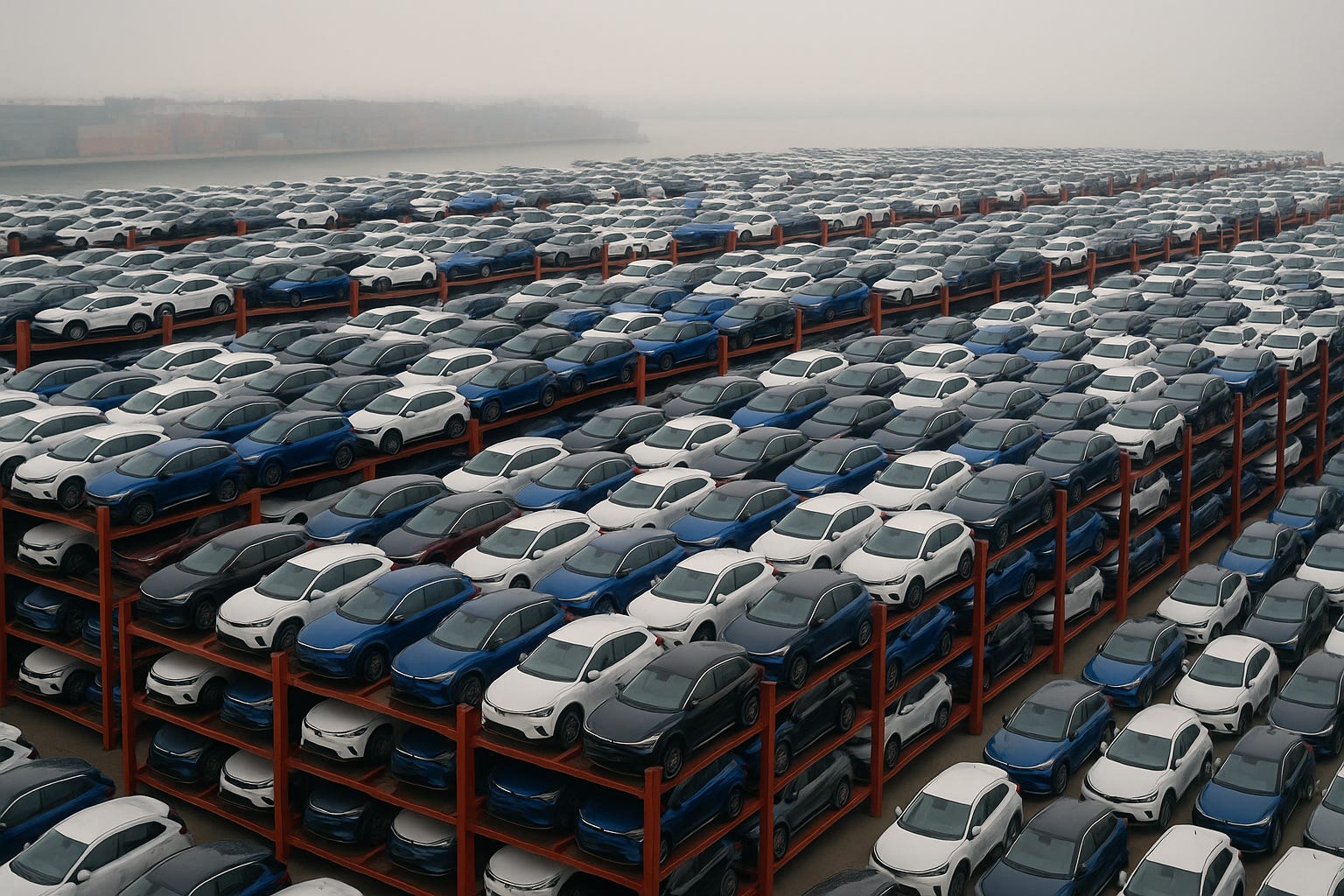
You can see the future first in San Francisco, but perhaps also in the backseat of a BYD.
I recently spent a few weeks in China. Out of everything, the cars taught me the most. They turned out to be an excellent lens into China's past and future economy. Most of all, they taught me that most people are still underestimating the scale and type of competition that China is bringing. Here is what I saw, mostly filtered through the lens of China's car industry.
Chinese car companies & Western car companies
First, I think that Chinese car companies are strongly outcompeting Western counterparts. They are simply making higher quality, more pleasant cars with better features at a cheaper price point. These cars are shockingly well designed. They're innovative in a bunch of delightful small ways. They seem to me like they understand customers better. A prime example was the Zeekr minivan: its armrests had airplane-style trays that extended out of the seat.
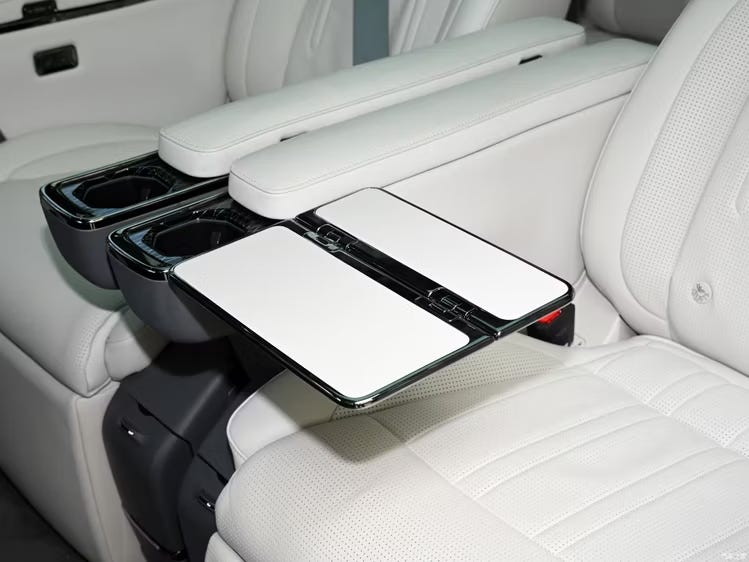
It's a small thing, but it makes a huge difference if you're doing work on a laptop in a car. Somehow I've never experienced that anywhere else. On top of that, the seats were very comfortable and you could lay back a lot. It would have been easy to take a nap. And, if you wanted, you could then wake up and be entertained by the screen that dropped down from the ceiling with built-in karaoke! It was quite the experience. After a ride in a Zeekr I had the thought that this was the obvious and preferred choice for me for long rides. I'd choose it over comparable alternatives (minivans, SUVs, etc) that I'd typically get in America.
The Zeekr wasn't the only brand we had that experience with. Across BYD, Xiaomi, Stelato, etc the cars were shockingly nice. After riding in these brands a few times, I started to feel disappointed to be picked up in a premium Western brand (BMW, Audi, etc). That was a surprising realization. In my opinion Tesla is the only Western brand that would rival them in terms of passenger UX and design.
In America Tesla feels to me like a unique, boundary pushing product in a relatively stagnant market. But, in China the same product is just one of many contenders in a fiercely competitive field. That intense competition is a powerful accelerant that creates a more dynamic market, sharpens up companies, and is leading to better products with a wider variety of choices.
If I were buying a car today Tesla would win out over its Chinese competition. But not by that much. These are not the "low quality copy" kind of products that China has mostly been known for thus far. And the remaining gap that exists between Chinese and Western EVs seems to be closing fast too, as Chinese brands continue their fast iteration. One example that was striking to me: Xiaomi, a company mostly known for smart phones, went from producing its first car in 2024 to setting a new speed record for EVs in 2025.
Competition
Second, the car industry reveals how China's political system creates and channels competition. Investigating the industry, one thing immediately stood out was the central government repeatedly reprimanding the car industry for having too much competition. How did that come to be?
As I understand the problem at its core is a political one. All around the country political leaders are being evaluated in what amounts to a massive promotion tournament. The central government sets broad growth targets; provincial leaders get wide discretion for how to hit them. If an official grows jobs or industrial output faster than their peers - while keeping society stable - they get promoted.
This creates a structural incentive for every province to cultivate its own industrial champions. Every province wants their own car company, a steel mill, an AI lab. Even if that isn't necessarily profitable, it does move the metrics that matter for these cadres. And since they are evaluated against their peers, then they would fall behind if their peers are investing in something they are not. Copying is safer for your career than betting on new niches.
Political competition of this kind has created ruthless industrial competition and economic growth. Each local government backs their own champions for the same market niches, encouraging them with subsidies and other benefits. And, as a result, there are dozens of firms crowding into the same markets and competing vigorously. Indeed, competition has been so intense that Beijing has had to step in multiple times to temper it.
The benefits of this model for cars are obvious: the products are great, surplus flows to consumers, and it sharpens firms up to be globally competitive. But there is too much competition and this creates problems of its own. It leads firms to compete in "low-quality" ways like undercutting quality of services and reducing margins. Indeed, it prevents some firms from making a profit at all. By extension, too much competition prevents firms from paying higher wages and investing more in r&d. In turn that also undermines long-term profitability and innovation.
Fixing this is key to Beijing's goals for the economy, and highlight the limits of this model of growth. A glut of competition will be difficult to fix for China because of how the political system's structure contributes. Moreover, this makes exports even more important, but ensuring open foreign markets will be a similarly challenging political process.
In some ways the Chinese market for EVs is a mirror image of the American market. America has one dominant, massively valuable EV champion: Tesla. In China there are dozens of EV companies brutally competing, but they're not worth nearly as much. If you looked across the two economies, I suspect this dynamic would be repeated quite a bit. Both countries would benefit from moving towards the other's position a bit. America's markets would benefit from more competition, China the reverse.
Innovation
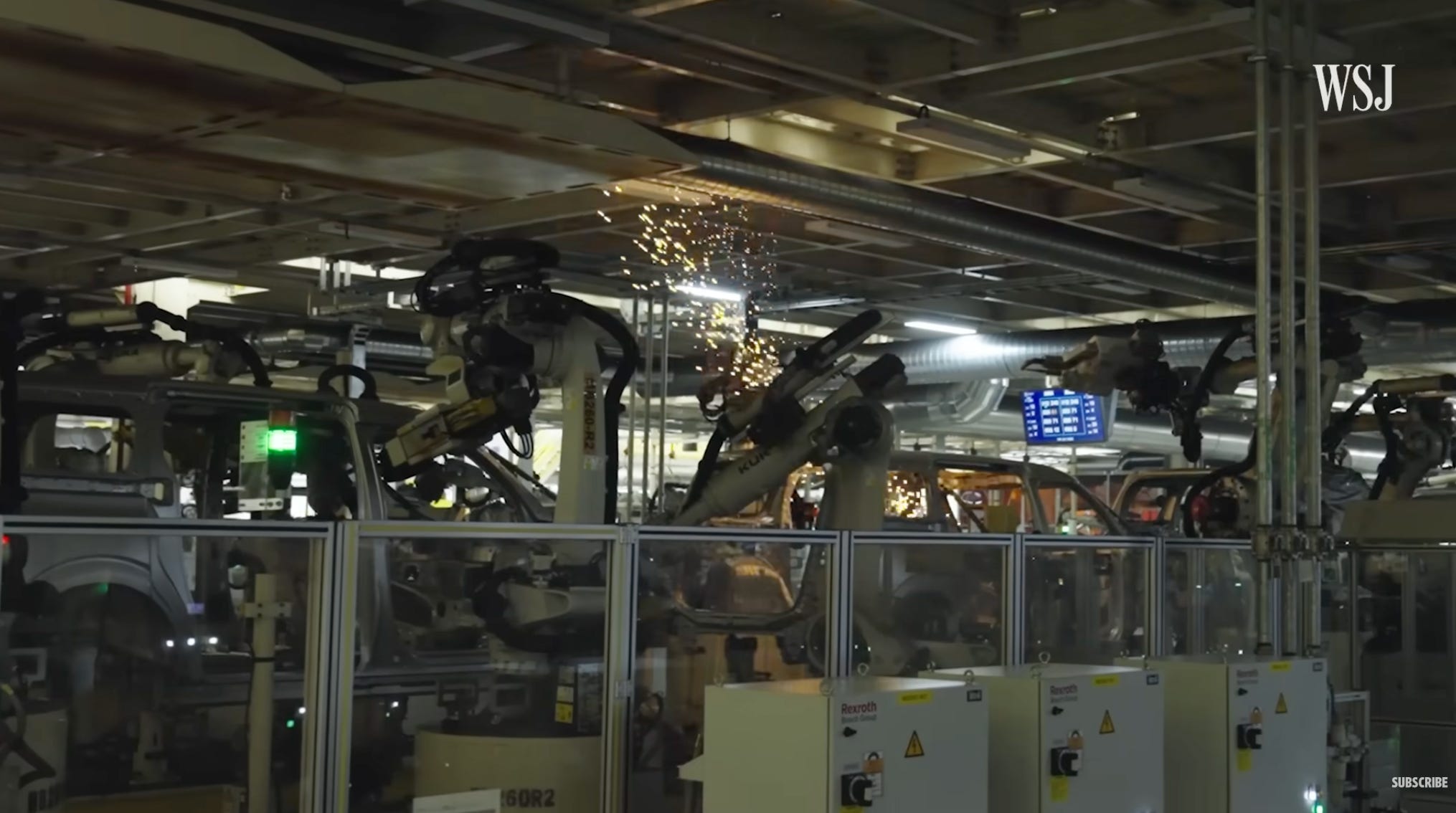
Third, cars are a showing of the strength of Chinese innovation. The refrain that China steals and can't/doesn't innovate seems to me to be cope. To put it simply: the cars were pleasant and innovative in ways I mostly hadn't felt from Western vehicles. They are surprisingly cheap too, and some amount of that is from industrial policy but certainly not all of it. The factories behind these cars are also full of industrial innovation - some so automated they could be run without any lighting because humans are not needed.
Anecdotally, I talked to a few smart Chinese folks working on frontiers that would tell me something like "For new breakthroughs America is still the best in the world. For everything else, China is better." It is, I'm told, particularly difficult to work on a frontier where there isn't much government support. So, a lot of energy is spent on getting the right government official to pay attention to their work. However, the perception was that government officials pay the most attention to what other countries like America thought was broadly important, and not leading the way themselves.
New breakthroughs are the obvious place where American innovation is stronger, while China shines mostly in scaling technologies. But, in general, I think Americans underrate scaling as a type of innovation itself. Industrial efficiency, quality control, automation, and organization are all forms of innovation. And scaling a technology tends to be what wins jobs, market, and political leverage - not just having the breakthrough. A breakthrough that cannot be scaled effective is a missed opportunity for America and a new opportunity for China.
Another area there is much to say about is renewables. But I have less firsthand experience here. So I'll just suggest the reader investigate this more themselves. I was particularly drawn to the story of Pakistani citizens DIY installing 25 gigawatts worth of cheap Chinese solar panels in a country whose entire grid only boasts 50 gigawatts of capacity.
Final thoughts
Altogether I left China with the sense that it was a much more dynamic place than most in the West realize. Everyone knows China is a country with industrial might. But it is also on the brink of having much more than that. It is pushing the frontier of technology, backed by fiercely driven entrepreneurs making great products in insanely competitive markets.
Thus far, us Americans have mostly been shielded from this because those products mostly aren't sold here, and don't reach our feeds. That probably won't hold for much longer. Ignoring industrial politics for a moment, excellent EVs and renewable energy are undeniably charismatic. The rest of the world will want these products. They will likely do well where the trade barriers aren't too high. And where the trade barriers are too high, then at some point these products will be wanted by consumers unless competitors can step up their game.
Beyond the hard products of cars and energy, I also expect more success from Chinese "soft" products. This was visible in small, everyday ways: the design of coffee cups, better app UX, fashion brands that rivaled Western counterparts, etc. Indeed, we've already started to see this in America with the success of apps like TikTok, brands like Labubu or Luckin, and in stories like the Three Body Problem. You can't scale or steal your way to success with any of these. They require creativity, taste, and an understanding of consumers.
Despite all of the handwringing and alarm in America, it still feels like most people profoundly underestimate the nature of the competition China poses. The real story here is not that the cars are impressive, but rather that China is pushing the frontier of technology. Not as much in having breakthroughs yet, but decisively in scaling them to the world and increasingly in turning them into great products that rival Western ones.
Acknowledging China's role on the technological frontier should raise difficult questions: do liberal democracies have as much of an edge in innovation as we once believed? Is freedom necessary to sustainably push the technological frontier? What would happen if the most charismatic new technological and cultural products were made outside of the West?
I don't pretend to have the answers to any of these questions. But I am sure they are not being asked nearly as much as they should be. It is not a given that the future comes from our Bay Area instead of the Greater Bay Area.
Thank you to Tina He for the review and our many conversations about China.